Ever since it was announced last week that Apple CEO Steve Jobs would present iCloud at WWDC 2011, there has been a deluge of rumors and guesses as to what it might be. Now, we have the answers.
Jobs noted at the keynote that the cloud has “demoted” the PC and Mac to just mere devices, and iCloud will step in as the “center of your digital life” and digital hub. Those are some lofty goals, but that is where Apple thinks computing is headed these days.

MobileMe, which Jobs noted was not Apple’s “finest hour” (to say the least), is basically being reworked from the ground up and turned into iCloud. Actually, it doesn’t really even exist anymore (at least in Jobs’ memory).
The idea behind iCloud is simple: iCloud stores content and then pushes it wirelessly to all of a user’s devices. That goes for contacts, calendars, new emails, etc. Basically almost everything you sync in iTunes via USB can be done via the cloud now. Users can only backup data using Wi-Fi connections, which might seem limiting but it should save anyone from outrageous data costs.
The big focus on iCloud centered around music. For days, weeks, whatever - everyone has been wondering what Apple was going to announce regarding a cloud-based music streaming service. However, we didn’t get what most people expected.
The first surprise was that there will be no charge for multiple downloads to multiple devices. The key word is “multiple,” not unlimited. Users can just hit a “Purchased” button in iTunes on their various devices and push what is already purchased and downloaded to nine other iCloud-enabled gadgets.
Secondly, iTunes for iCloud isn’t actually a competitor for Google Music, Amazon’s music service or anything else like that. There isn’t a subscription-based model involved here, but rather the usual purchase model that already exists. The only difference now is that users can just push the songs to multiple devices wirelessly and much easier.
The closest it gets to the streaming service is the new iTunes Match. Users who have pirated MP3s on their computers can try to go back to the honest and good side of things by using this software that scans the hard drive and then matches the titles to 256Kbps AAC, DRM-free tracks. (That must be where Apple’s latest deal with the music industry came in.) Jobs promised this scan would take only “minutes” and that it costs $24.99 per year “regardless” of the amount of songs.

Some of the other tidbits included in iCloud include a @me.com account, a no-ads promise, and a new feature in the App Store that shows the user its previous purchases (i.e. mobile apps, iBookstore items, etc.) that are waiting to be pushed down to other devices.
Apple also appears to be targeting a more business-minded bunch with the new Documents in the Cloud function. This feature incorporates the iWork suite (Pages, Numbers, and Keynote) and follows the idea of the cloud: users can work on projects using one of these apps using an iPad and then pick up where one left off using a PC. iCloud will also sync up the Camera library among multiple devices using Photo Stream, which pushes the last 1,000 photos taken on any of the iCloud-enabled devices to the rest. These images will be stored to their own album, but they’ll only be kept there for 30 days. If a user wants to keep them, then the selected images must be moved to a different, specified album.
Although it was widely rumored that Apple would charge $25 per year for iCloud usage (versus the $99 MobileMe yearly subscription fee), Jobs said that iCloud will be free. Yes, free - except for that whole iTunes Match fee if you opt into it.

Like iOS 5, the developer preview will be available starting today, and the full version will launch this fall. iCloud will offer 5GB of storage space, but purchased music, e-books and photos don’t count towards that total.
I think a cloud-based operating system, like Google’ Chrome OS, has a bright future. But, when I look at Apple’s Lion, which will only be available as an upgrade by a 4GB download, and iCloud plans I begin to wonder just how much any fat-client operating system-Linux, Mac OS X, or Windows-have if Apple and Google have their way.
As Jobs put it, the PC centric data model is broken. And, so the digital hub will move from being the PC to the iCloud and the Mac will be “demoted.”
What did he mean by that? My fellow ZDNet writer, Andrew Nusca, put it well, “Mac vs. PC vs. Linux argument from the early days of consumer computing has lost a great deal of its luster in recent years with the development of cloud computing on the open web.” The operating system wars are far from over though. Nusca continued, “Concept of platform wars is quickly making up for lost ground with the development of cloud computing in the closed mobile space.”
I’ve always thought that thin-client computing has its place in technology. That’s one reason why I think Google’s Chrome OS has a real shot in dethroning the Window desktop in the office. By making the iCloud the center of everything, instead of the Mac, Apple is trying to wean consumers away from the fat-client PC model that’s served us so well since the day the first IBM PC rolled off the assembly line.
This worries me. If you had fast bandwidth and enough room on your data cap, cloud-based computing is fine. Many of us are already using every day. Oh, you may not think of using Gmail or Google Docs as being on the cloud, but it is and you are.
It’s so darn easy when all you really need to get work done from anywhere is an Internet connection and a Web browser. Forget your file at the office? Just grab your copy from Dropbox, and you’re good to go. But, Jobs takes it even farther. All your data will be on the iCloud and it’s automatically pushed to any of your devices.
It sounds great doesn’t it? I think it sound great too, but, and this is a big one, do you really want to trust Apple or Google with all your data? What happens if you don’t pay your fee to Apple? What happens if the Recording Industry Association of America (RIAA) demands a copyright audit of all my music on iTunes Match?
You see, I rather like the idea of owning all my media and having it on my servers and PC. This leads me to my other point: I like owning my operating system and applications.
Microsoft will sell me a system, with caveats, but at the end of the day I own it. I have a friend who’s still running Windows XP Media Center 2002. It still works for her and she’s happy with it. That’s great. I’m a big believer in the idea that if something works for you, you should keep using it.
But, as I sit here my with my first generation iPod Touch and Apple TV, neither of them work well with the latest Apple software offerings. Do I want to be forever having to upgrade my Apple hardware to get the most from Apple’ newest features?
At least with Google, the plan is to support the lowest common denominator. If you can use the Chrome Web browser or afford an inexpensive Chromebook, you can use the full-range of Google’s cloud-based services. My friend, for example, uses Chrome 11 on her almost ten-year old PC without a problem.
The problem extends beyond just “owning” an operating system, your application and your data. With Linux, it’s about having control of your operating system.
Richard M. Stallman, creator of the GNU Public License (GPL), developer, and leader of the Free Software Foundation and I disagree on many points. But, when he recently disparaged cloud computing. I had to agree.
Stallman said that in cloud-computing you’re letting “any Tom, Dick and Harry hold your data, let any Tom, Dick and Harry do your computing for you (and control it). Perhaps the term ‘careless computing’ would suit it better.” Stallman fears, “many people will continue moving towards careless computing, because there’s a sucker born every minute. The US government may try to encourage people to place their data where the US government can seize it without showing them a search warrant, rather than in their own property. However, as long as enough of us continue keeping our data under our own control, we can still do so. And we had better do so, or the option may disappear.”
He’s right. With a Linux desktop computer, I own my data, I control my processes. While I can see the cloud having its place for some people and in some situations, I hate this trend we’re seeing of putting everything into someone else’s hands outside of our sight, and all too soon out of mind.
Thin-clients and cloud-computing do have their place, but it’s not a place where I want my data, my work, to live under the control of corporate strangers. For all the ease of use of these methods, I’d prefer to see fat-client desktops like Mint 11 Linux, and, yes, even Windows 7, to continue on for so long as we continue to use computers.
Apple is set to launch its iCloud service which will allow the users stream data stored on Apple servers to their devices including iPhones, iPads and iPods. Don’t think of iCloud as the new MobileMe, think of iCloud as the new iTunes.
The service will be directly competing against similar services launched by Google and Amazon. Cloud computing is going to prove crucial because the mobile devices battle is no more a battle between devices.
What is Cloud Computing?
Let’s say you’re an executive at a large corporation. Your particular responsibilities include making sure that all of your employees have the right hardware and software they need to do their jobs. Buying computers for everyone isn’t enough you also have to purchase software or software licenses to give employees the tools they require.
Whenever you have a new hire, you have to buy more software or make sure your current software license allows another user. It’s so stressful that you find it difficult to go to sleep on your huge pile of money every night.
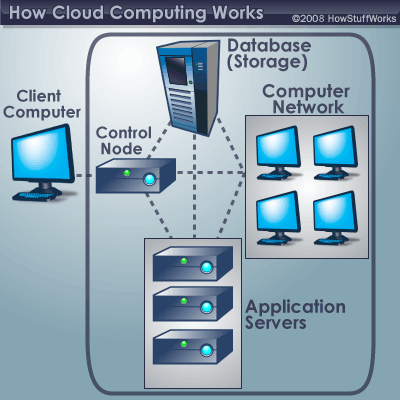
Soon, there may be an alternative for executives like you. Instead of installing a suite of software for each computer, you’d only have to load one application. That application would allow workers to log into a Web-based service which hosts all the programs the user would need for his or her job.
Remote machines owned by another company would run everything from e-mail to word processing to complex data analysis programs. It’s called cloud computing, and it could change the entire computer industry.
The iCloud has the potential of changing the very basic pattern of media consumption, which in turn may increase demand for more Apple devices among the masses. The iCloud itself may not be something revolutionary, but the forthcoming gadgets designed around it may indeed turn out to be a million dollar opportunity for Apple.
At a time, when Google and Amazon went ahead and launched their cloud services without taking music labels into confidence, Apple took a different route and successfully negotiated with the major music labels. The iCloud service from Apple, however, is much more than just music based service. Users can store almost any type of data in the cloud and access it from almost all of their Apple devices including iPhone and iPad.
It’s not the first foray of Apple in the cloud. It’s earlier web based service, MobileMe — a platform for online services and software from Apple – did not exactly take off at the start, and the service had several breakdowns in its life. Despite its shortcomings, MobileMe in the end ramped up three million users, not bad indeed, but it still is just a fraction of the total number of users iCloud is expected to bring to the Apple.
The New York Post is reporting that Apple will pay more than $100M in up-front payments to the four major music labels (Sony, Universal, EMI and Warner) in a licensing deal for their new iCloud service. Apple has confirmed the announcement of their iCloud service will be made at their Worldwide Developer’s Conference on June 6.
The labels get between $25-50M each, with the variations coming from how many tracks from each label users are storing with Apple’s service. Apple has more than $60B in cash reserves, so a $100M+ investment for a service that could conceivably sell more iPads and iPhones seems to be a no-brainer.

The upfront fees were a major issue stalling the Google negotiations. Now that Apple has set a precedent, Google could realistically have a similar licensing agreement implemented by September.
Apple is expected to implement the cloud service for free, with plans to change to paid subscriptions in the future; seemingly once users are sufficiently hooked. The Cupertino tech giant’s cut of future subscription fees will be 18 percent. 12 percent will go to publishers and the remainder given to the labels. The LA Times also reports that Apple will also subsidize the cost of implementing the service with advertising.


